Cyber resilience is a leadership decision.
NIS2 connects critical services, cybersecurity measures, incident reporting and management accountability. Understand who may be in scope, then organise the work across teams.

Start with the organisation, not the acronym.
Sector is only one part of the question. Entity type, size, exceptions, establishment and national law all shape the analysis.
How to assess scope ↗Resilience has to be owned.
Connect management decisions to the services at risk, the measures in operation and the evidence of review.
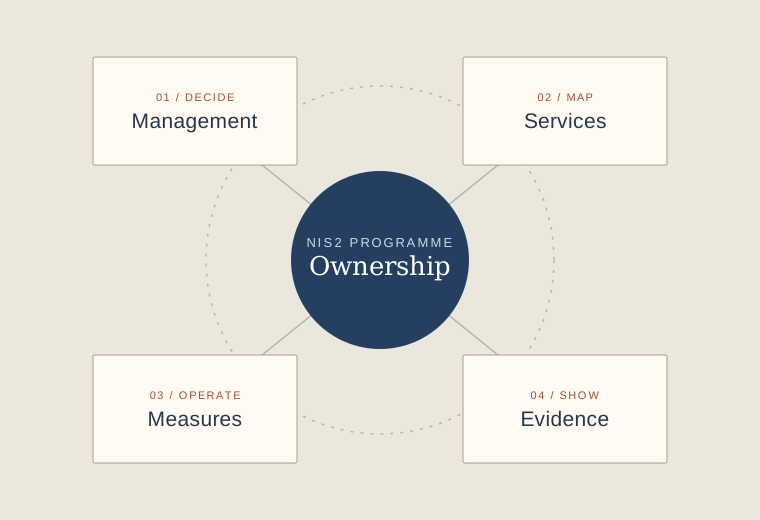
Management
Make approvals, oversight and training visible.
Services
Understand what the organisation needs to keep running.
Measures
Assign owners to risk management and incident preparation.
Evidence
Keep decisions, tests and follow-up in a usable record.
Four workstreams to organise.
Cybersecurity risk management
Build proportionate measures around risk analysis, policies, incident handling, continuity, supply chain and other areas listed in Article 21.
Art. 23Incident reporting
Prepare to assess significant incidents and make staged notifications through the relevant national route.
Art. 20Management accountability
Management bodies have a role in approving and overseeing cybersecurity risk-management measures and receiving relevant training.
Art. 21(2)(d)Supply-chain security
Consider security-related aspects of relationships with direct suppliers and service providers within the risk-management measures.
Know the reporting path before the clock starts.
Article 23 describes staged notification for significant incidents. Confirm the applicable national channel and the circumstances of the event.
Early warning
After awareness of a significant incident, subject to the Directive’s conditions.
Incident notification
An initial assessment updates the early warning where applicable.
Final report
Generally measured after notification; Article 23 gives the detail and exceptions.
Move from interpretation to operation.
A practical route gives every phase an owner and an output. A generic checklist alone cannot establish compliance.
Scope
Map entities and services
Assess
Review risks and measures
Prioritise
Assign decisions and owners
Operate
Test, document and review
Working notes for the decisions ahead.
Starting a NIS2 scope review
A NIS2 scope review answers one question with evidence: is this legal entity, for these services, in this Member State, an essential or important entity under Directive (EU) 2022/2555 as implemented in national law? The review works through the entity, the annexes, the size rules and the exceptions, and ends in a written decision that can be revisited when the business or the law changes.
No. 2 · GovernanceEvidence for management oversight
Article 20 of Directive (EU) 2022/2555 makes the management bodies of essential and important entities responsible for approving cybersecurity risk-management measures and overseeing their implementation. Oversight that cannot be evidenced did not, for supervisory purposes, happen - so this guide sets out the records that show approval, oversight, training and follow-through as part of normal governance.
No. 3 · Incident reportingPreparing an incident notification workflow
Article 23 of Directive (EU) 2022/2555 puts covered entities on a staged reporting clock once they become aware of a significant incident: an early warning within 24 hours, a fuller incident notification within 72 hours, and a final report within one month. Those deadlines are only manageable if triage, decision rights and fact capture are designed in advance. This guide sets out the workflow to build before an incident tests it.